Why the future of school management isn’t buying another platform – it’s replacing them all with one.
Every School Knows Its Staffing Budget. But Very Few Know Their Software Budget.
Ask any Headteacher, School Business Manager, or Chief Financial Officer what their annual staffing costs are, and you’ll likely receive an answer within seconds. Ask about energy bills, catering contracts, or building maintenance, and the figures are equally familiar.
Now ask a different question: How much does your school spend every year on software?
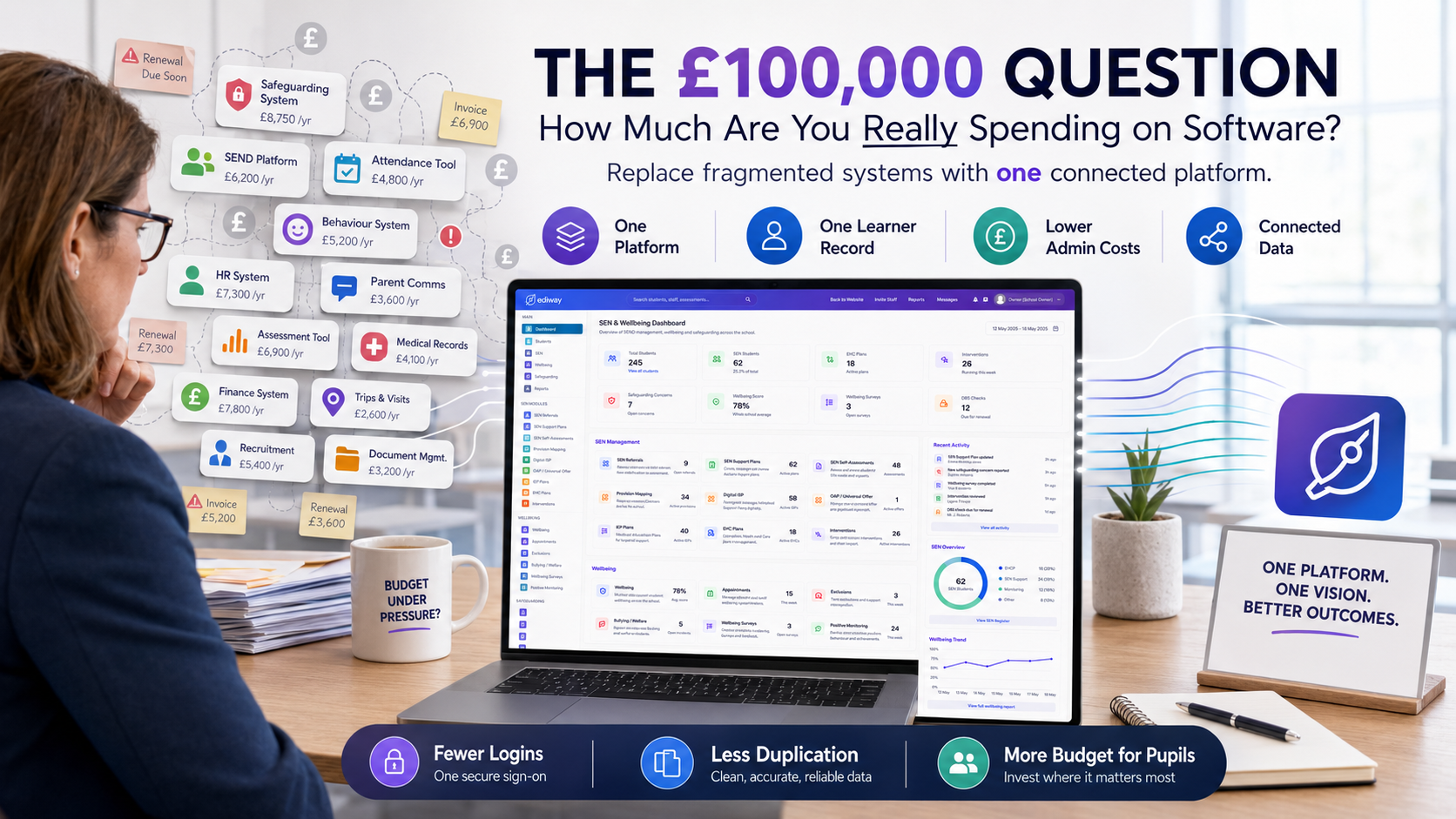
For many schools, the answer isn’t straightforward. This isn’t because the information doesn’t exist, but because software procurement has become deeply fragmented across departments, budgets, and suppliers. The safeguarding team has one platform. SEND has another. Attendance, behaviour, assessments, parent communication, HR, medical records, finance, governors, and recruitment often all use entirely different systems – each purchased at different times and renewed under different contracts.
Individually, each subscription appears affordable. Collectively, they represent one of the largest hidden operational costs in modern education. At a time when schools are being asked to deliver more with fewer resources, it is worth asking a simple but crucial question: Are schools investing in education, or are they simply paying to manage disconnected technology?
The Hidden Cost of Digital Fragmentation
Over the past decade, education technology has grown rapidly. Whenever a new challenge emerged, a new platform followed. Need to improve safeguarding? Buy safeguarding software. Need SEND tracking? Purchase another platform. Better attendance monitoring? Add another subscription.
On paper, every decision makes sense, as each solution promises to solve one specific problem. The difficulty begins when schools discover that none of these systems were designed to work together. Instead of creating a connected digital school, many institutions have unintentionally built a patchwork of disconnected applications. Every new platform brings:
-
Its own isolated database
-
Its own login and permission settings
-
Its own support contract and renewal date
-
Its own training requirements and implementation process
The result isn’t simply higher costs; it is exponentially higher complexity.
A Typical School’s Software Portfolio
While every school is different, many purchase software across a broad range of operational areas. It is not uncommon for a school to maintain entirely separate systems for their MIS, attendance, behaviour, safeguarding, SEND/EHCP management, assessments, parent and staff communication, medical records, HR, recruitment, visitor management, asset tracking, clubs and trips, online payments, timetabling, and document storage.
Every one of these systems has value. However, each additional platform introduces another annual subscription, another supplier relationship, and another place where data must be manually maintained.
What Does This Actually Cost?
Software pricing varies considerably depending on school size, pupil numbers, and required functionality. However, based on common pricing across the education sector, a realistic annual software expenditure for many schools looks something like this:
| Platform Category | Typical Annual Cost |
| Management Information System (MIS) | £4,000 – £12,000 |
| Safeguarding | £1,500 – £5,000 |
| Parent Communication | £1,000 – £4,000 |
| Attendance & Behaviour Management | £1,300 – £5,000 |
| SEND Management | £1,500 – £6,000 |
| Assessment Platform | £2,000 – £8,000 |
| HR & Recruitment | £2,000 – £9,000 |
| Medical Records | £500 – £2,500 |
| Visitor & Asset Management | £1,300 – £5,000 |
| Governors Portal & Document Storage | £1,000 – £4,500 |
| Online Forms & Digital Signatures | £600 – £2,200 |
| School Website & AI Tools | £1,000 – £6,000 |
| Clubs, Trips & Staff CPD | £1,500 – £7,500 |
Note: These figures are illustrative, but they demonstrate how subscription costs rapidly accumulate over time.
The Real Annual Cost
When these individual subscriptions are combined, annual expenditure becomes substantial. Even excluding implementation costs, bespoke integrations, premium support packages, and the staff time spent administering multiple systems, the baseline software spend is staggering:
| School Type | Estimated Annual Software Spend |
| Small Primary | £25,000 – £40,000 |
| Average Primary | £35,000 – £55,000 |
| Large Primary | £45,000 – £70,000 |
| Small Secondary | £50,000 – £90,000 |
| Average Secondary | £80,000 – £140,000 |
| Large Secondary / MAT School | £120,000 – £250,000+ |
The Cost Nobody Measures
Subscription fees are only part of the equation; the greatest expense is frequently staff time. Every duplicated task has a financial and emotional impact.
Consider a simple safeguarding concern. Information might first be entered into the safeguarding platform. Relevant attendance information is then checked elsewhere. Behaviour history sits in a third system, medical information in a fourth, and SEND documentation in a fifth. Before any professional judgement is even made, staff have already spent valuable time hunting down information from multiple sources. Multiply this process across hundreds or thousands of pupils every year, and the hidden cost of fragmentation becomes enormous.
Administration Is Growing Faster Than Education
Technology should reduce workload, but too often, it increases it. Schools regularly report spending countless hours on duplicate data entry, importing and exporting spreadsheets, maintaining integrations, resetting passwords, and reconciling conflicting information. None of these activities directly improve outcomes for pupils. They simply keep disconnected systems functioning.
Imagine Replacing Twenty Platforms With One
This is where education technology must evolve. Instead of asking schools to purchase another specialist application, the better question is: What if schools no longer needed twenty separate systems?
Imagine one secure platform that combines School Management Information, Attendance, Behaviour, Safeguarding, SEND, EHCP Management, Assessments, Wellbeing, Parent Communication, Staff Collaboration, AI Insights, Medical Records, Reporting, and Compliance. Instead of information being copied between systems, every update becomes part of one connected learner record. Every authorised professional sees the same trusted information, and every department works from a single source of truth.
Introducing EdiWay
EdiWay has been designed around one central principle: Education works best when information is connected.
Rather than developing another standalone application, EdiWay provides a unified education platform capable of replacing the vast majority of the systems schools currently operate independently. From admissions through to wellbeing and AI-assisted analytics, information is stored once and used intelligently across the platform. The result is fewer logins, less duplication, greater visibility, lower administration, and better decision-making.
What Could Schools Save?
If a school currently spends approximately £40,000 each year across multiple software subscriptions and can replace much of that estate with EdiWay at around £1,000 per month (£12,000 annually), the potential reduction in direct software costs alone could exceed £28,000 per year. For secondary schools or MATs with substantially larger software estates, the potential savings are transformative.
The financial benefit, however, is only one part of the equation. By consolidating systems, schools also drastically reduce procurement workload, onboarding time, annual renewals, IT support overheads, and staff training requirements. Every hour saved allows teachers and leaders to spend more time directly supporting pupils.
The Bigger Opportunity
The conversation about school budgets often focuses on funding. Funding absolutely matters, but so does spending wisely. Every pound saved on unnecessary software duplication is a pound that can be immediately redirected towards:
-
Classroom resources and enrichment opportunities
-
Teaching assistants and intervention programmes
-
SEND provision and pupil wellbeing
-
Staff development and retention
Technology should support education – not compete with it for limited budgets.
One Platform. One Budget. One Connected Future.
Education is entering a new era. Artificial intelligence, data-informed decision-making, and integrated services are transforming how schools operate. Yet, many schools are still managing dozens of disconnected systems built for a different generation.
The next evolution is not another specialist application. It is a connected education ecosystem. One secure platform. One learner record. One source of truth. One predictable subscription.
At around £1,000 per month, EdiWay represents more than a software platform – it represents a radically different way of thinking about education technology. Rather than asking “Which platform should we buy next?” schools should begin asking, “How many platforms could we replace?”
For many, the answer could transform not only their technology estate but their finances, staff workload, and capacity to focus on what matters most. Every pound spent maintaining fragmented systems is a pound that cannot be invested directly in children. The smartest investment isn’t another piece of software. It’s one platform that brings everything together.