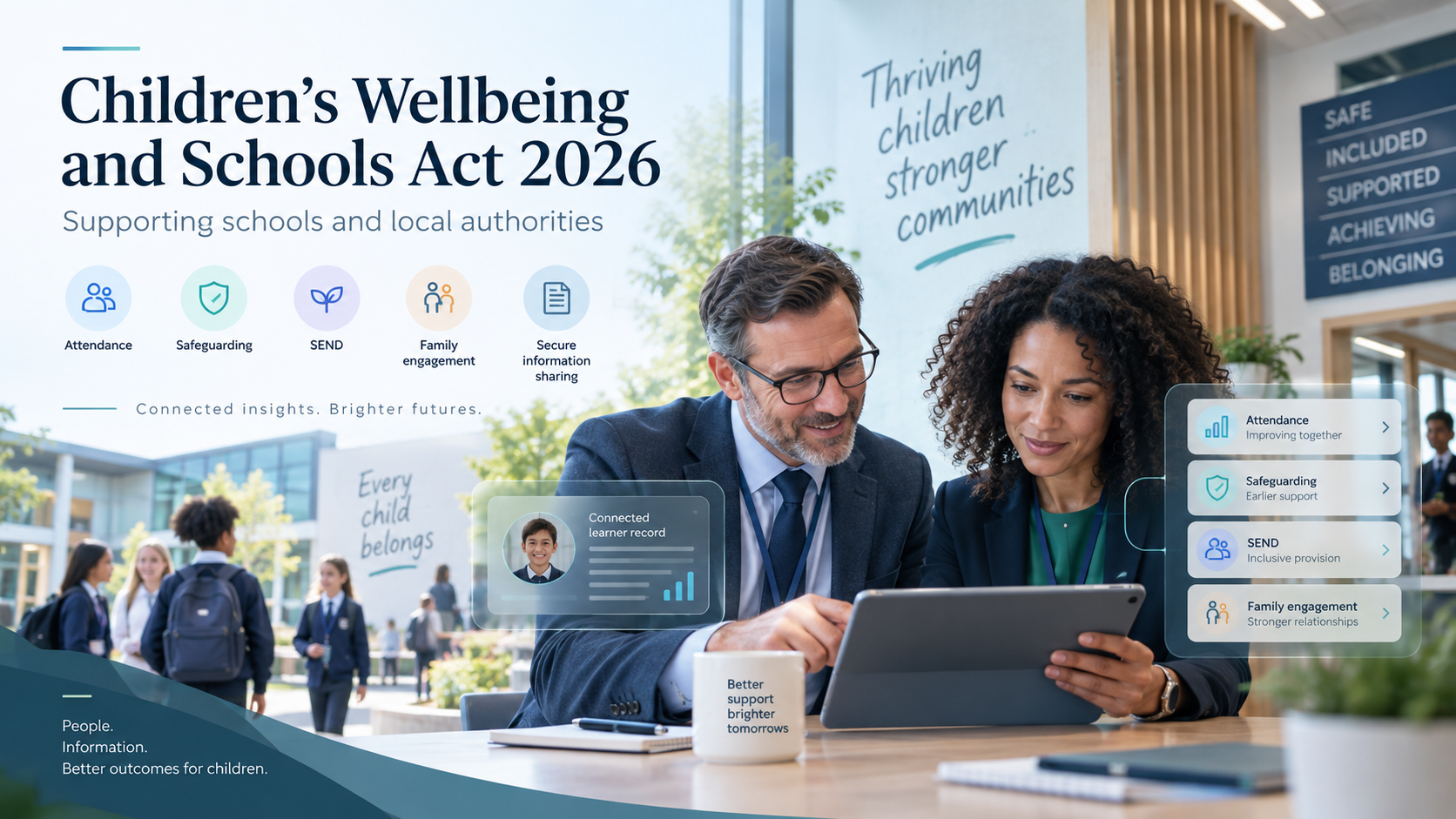
EdiWay’s latest platform developments strengthen the connected learner records, evidence, information-sharing and cross-organisation workflows that schools and local authorities need as the Children’s Wellbeing and Schools Act 2026 is brought into operation.
The Children’s Wellbeing and Schools Act 2026 received Royal Assent on 29 April 2026. It introduces wide-ranging reforms intended to strengthen children’s welfare, improve educational oversight and raise standards, with measures affecting schools, local authorities, families and other organisations supporting children and young people.
The legislation covers areas including school attendance, children not in school, home education, safeguarding, school food and allergy safety, free school meals, uniform, admissions and other aspects of school organisation. Implementation is being phased, with individual provisions dependent on commencement regulations, secondary legislation and statutory guidance.
Schools and local authorities can read the full legislation on the Children’s Wellbeing and Schools Act 2026 legislation page.
Turning legislation into operational practice
For schools and local authorities, legislation is only one part of the challenge.
The practical question is how responsibilities are carried out consistently when a child’s education may involve a school, local authority, family, SEND professionals, safeguarding teams, alternative provision, health professionals or other authorised services.
That means being able to establish a learner’s current education status, understand who is responsible for the next action, record where information came from, share information appropriately, retain evidence of decisions and maintain a clear chronology as circumstances change.
Our latest work on the EdiWay School Platform is designed around those shared foundations.
Rather than creating an isolated “Act compliance module”, EdiWay connects learner identity, education status, attendance, SEND, safeguarding, family participation, professional collaboration, evidence, permissions and accountable workflows around the same learner record.
Our EdiWay White Paper explains the architecture behind this approach and how statutory and policy-sensitive workflows can be configured, versioned and evidenced without replacing the professional or statutory judgement of schools, local authorities or other responsible bodies.
Supporting home education and vulnerable learner decisions
One of the most significant areas of the Act for schools and local authorities concerns children moving from school into home education.
The Act establishes additional safeguards around the withdrawal of certain vulnerable children from school. For children within the specified circumstances, the legislation provides for local authority involvement and consent before removal from the school roll can be completed. This includes particular situations involving safeguarding concerns and certain children receiving special educational provision.
Operationally, this requires more than recording that a parent has requested home education.
Schools and local authorities need a reliable sequence that can connect the request with the learner’s existing education status, relevant vulnerability information, evidence, local-authority consideration and decision, and the eventual change of education status where appropriate.
EdiWay’s architecture supports this type of governed workflow: from the initial family request, through vulnerability and consent checks and local-authority action, to the eventual school status change. Importantly, the platform does not make the statutory decision itself.
The wider pathway is supported through EdiWay’s Families & Learning Pathways and dedicated Home Education capabilities.
EdiWay deliberately keeps home-education evidence distinct from school attendance. Family-created evidence remains attributable to the family, professional evidence remains attributable to the professional, and home education is not incorrectly represented as school attendance or EOTAS.
That distinction becomes increasingly important where information may later inform a local-authority review, SEND process, safeguarding decision or transition back into a school setting.
Preparing for Children Not in School responsibilities
The Act also creates a new statutory framework for Children Not in School, including local-authority registers and related information, support and information-sharing responsibilities.
The provisions include information about the child and parent, education being provided outside school, relevant education providers and the amount of education being delivered. They also provide for information to move between local authorities when a child relocates and for local authorities to offer support to parents whose children fall within the register framework.
These reforms are particularly significant because the information required will rarely originate from one organisation or one system.
EdiWay’s Children Not in School foundation has therefore been designed around an authority-owned record linked to the learner, their current education status, responsible authority, evidence, notifications, case activity and audit history.
The architecture supports governed parent and provider returns, correction and reconciliation workflows, support offers and recipient-specific information requests while preserving a record of what happened and when. As the detailed statutory framework is commenced and supporting regulations and guidance are finalised, configuration can be aligned with the applicable requirements rather than hard-coding assumptions into the learner record.
This connects naturally with EdiWay’s Professional Collaboration and Permissions, Consent & Information Sharing capabilities.
Attendance: evidence before escalation
The Act also reforms the School Attendance Order framework, strengthening the importance of evidence, communication and accountable decision-making where a local authority considers that a child is not receiving suitable education.
The statutory decision remains a human and local-authority responsibility. Technology should help responsible professionals understand the evidence and chronology behind that decision—not attempt to make it for them.
EdiWay’s Attendance & Registration model connects a learner’s current education status with registration, attendance marks, exceptions, follow-up activity and audit history.
This becomes particularly valuable where a learner moves between school attendance, alternative provision, home education or another recognised pathway. The purpose is to maintain an intelligible record of the learner’s circumstances rather than flatten different forms of education into a single attendance measure.
SEND and safeguarding information in context
For some children, decisions about attendance or a move away from school cannot sensibly be considered without SEND and safeguarding information.
The Children’s Wellbeing and Schools Act explicitly brings additional safeguards into some decisions involving vulnerable children, making reliable evidence and clear responsibility especially important.
EdiWay’s SEND, Safeguarding & Wellbeing tools keep these areas connected to the learner while maintaining the appropriate boundaries around sensitive information.
For SEND, the platform can support Assess, Plan, Do, Review cycles, provision and intervention evidence, and the evidence required for EHC processes and annual reviews through EHC Plan Evidence & Annual Reviews.
EdiWay does not issue an EHCP and does not replace a local authority’s statutory decision-making responsibilities.
For safeguarding, Safeguarding Records & Chronology provides controlled chronology, provenance and version history so that authorised professionals can understand what was known, when it was known and how information developed over time.
Governed information-sharing between schools and local authorities
A recurring theme across the Act is the need for organisations to work together without losing accountability for information.
The Children Not in School provisions, for example, establish specific information-sharing arrangements to support education, welfare and safeguarding functions and movement between local-authority areas.
EdiWay’s approach is to make sharing deliberate and traceable.
Where configured, the information-sharing record can establish what was shared, by whom, with which recipient, for what recorded purpose and at what time. Access can be scoped to the learner, case and role rather than giving every participating organisation unrestricted access to an entire record.
The wider governance approach is set out within Data Security & Governance.
For local authorities, trusts and schools working across organisational boundaries, this is fundamental. Collaboration should not mean losing sight of who owns the record, who made a decision or why information was shared.
Supporting duties that are already coming into force
The Act is being implemented in stages, so readiness is not only about future workflows.
For example, the new school allergy safety requirements under section 34 came fully into force on 1 September 2026, requiring relevant schools in England to have, review and publish an allergy safety policy and to have regard to statutory guidance.
Within EdiWay, medical and allergy information can remain linked to the learner and available within appropriate operational contexts without turning sensitive health data into unrestricted general information.
Schools can explore this through School Operations and Medical & Care Records.
Again, the distinction matters: EdiWay can support the evidence, information and workflow surrounding a school’s responsibilities. It does not certify that a school is legally compliant or replace the professional decisions required to keep an individual child safe.
One learner record across increasingly connected responsibilities
The Children’s Wellbeing and Schools Act demonstrates why learner information can no longer be considered solely within separate administrative systems.
- Attendance can intersect with SEND.
- A home-education request can intersect with safeguarding.
- Alternative provision can involve both a school and local authority.
- A family may contribute evidence that later becomes relevant to an EHC review.
- A learner moving between local-authority areas may require information and responsibility to move safely with them.
- EdiWay has been designed around that reality.
The platform can represent schools, trusts, local authorities, providers and shared services while retaining role-based boundaries and the provenance of information contributed by different parties. Multi-agency work can remain learner- or case-scoped, with responsible organisations, evidence, meetings and actions recorded without erasing organisational accountability.
Supporting statutory work – not automating statutory judgement
There is an important principle behind our latest work.
Technology should make statutory work easier to evidence, coordinate and understand. It should not quietly become the statutory decision-maker.
EdiWay can support workflow, evidence, chronology, notifications, permissions, information exchange and the implementation of reviewed policy rules.
It does not determine whether education is legally suitable, decide whether a child should have an EHCP, make a safeguarding judgement on behalf of a DSL, or guarantee that an organisation is compliant with legislation.
Those responsibilities remain with the schools, local authorities and professionals to whom the law assigns them. This distinction is embedded throughout the EdiWay White Paper and platform design.
Building readiness together
As implementation of the Children’s Wellbeing and Schools Act 2026 continues, schools and local authorities will need to translate national legislation and guidance into workable processes that remain understandable at learner level.
Our focus is to give those organisations a stronger digital foundation on which to do that: a connected learner record, clear education status, attributable evidence, controlled collaboration, auditable information-sharing and workflows that can evolve as regulations and statutory guidance evolve.
Schools, multi-academy trusts and local authorities can explore the current architecture through the EdiWay School Platform and read the underlying design and assurance approach in the EdiWay White Paper.
Readiness for the Children’s Wellbeing and Schools Act is not simply about recording more data. It is about making sure the right people can understand the right evidence, take the right action, and remain accountable for the decisions that affect a child’s education and wellbeing.