Every so often, a news story breaks that makes you stop, rub your eyes, and wonder if you’ve accidentally slipped into an alternate reality.
A recent report by the Daily Star highlighted a prime example of this institutional overreach: a primary school launching a strict crackdown to ban young girls from wearing shorts underneath their school skirts.
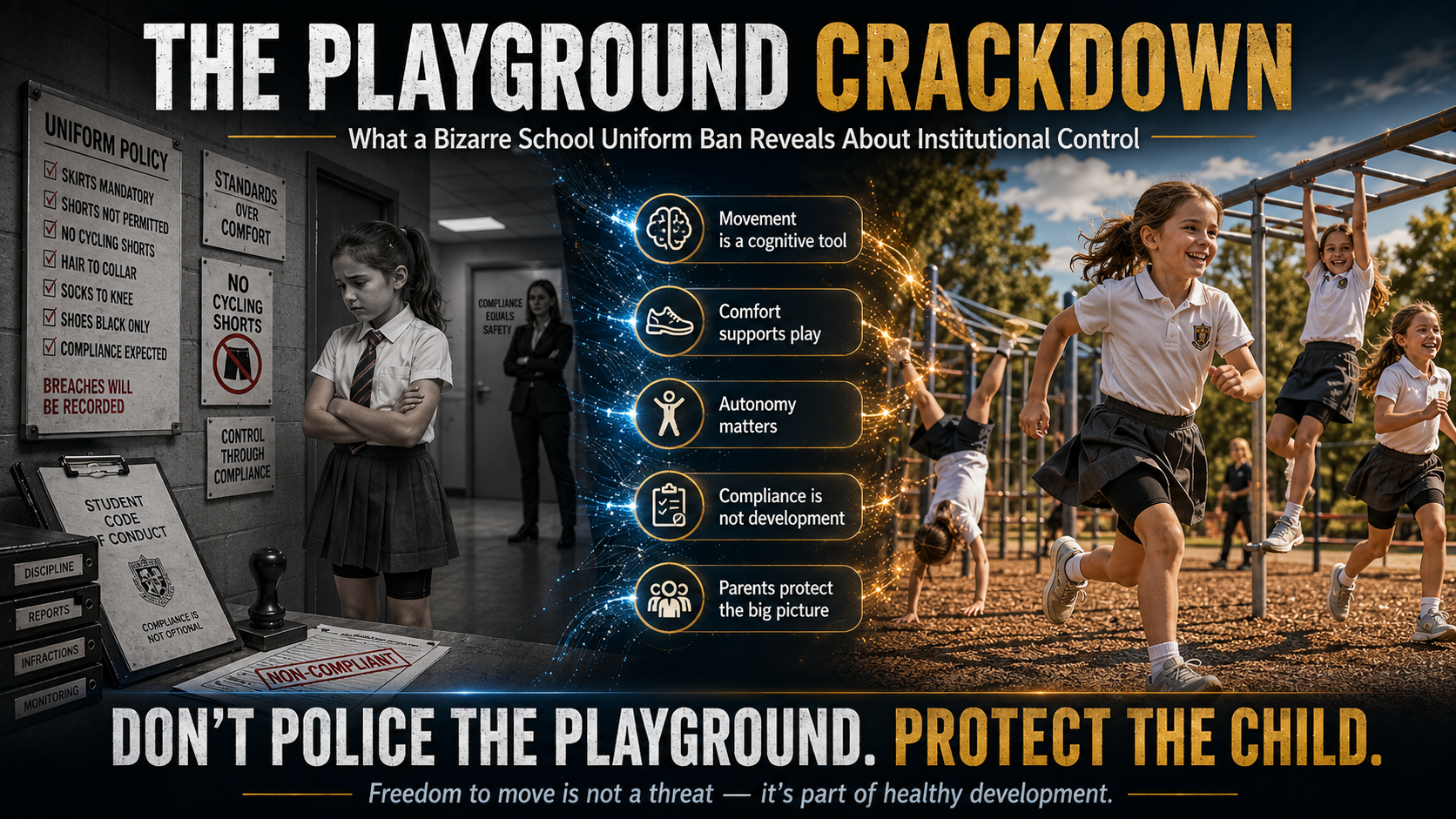
The rationale behind these kinds of rigid uniform policies usually rolls out under the banner of “compliance” and “standards.” But let’s look at the actual, real-world impact on the playground. Girls wear cycling shorts under their skirts for a very simple, common-sense reason: so they can play freely. They wear them so they can hang upside down on the monkey bars, do cartwheels, sprint across the grass, and sit comfortably on the hall floor without worrying about their dignity or being policed by adults.
Banning them doesn’t protect children; it actively restricts them. While we have previously exposed how uniform policies fail on sensory-friendly inclusivity and basic physical accessibility, this bizarre playground ban exposes a much deeper, more systemic issue: the institutional war on natural movement and autonomy.
Movement is a Cognitive and Sensory Tool
We often talk about the importance of movement in a child’s development. Physical movement is not a behavioral flaw—it is a vital cognitive and sensory regulation tool. Children, particularly kinetic learners and neurodivergent kids, need to move, roll, flip, and run to process their environments and clear their minds.
When a school spends administrative energy policing whether a seven-year-old is wearing a pair of comfortable cycling shorts under a skirt, they are sending a very clear message: rigid conformity matters more than your freedom to move.
By forcing young girls to choose between sitting perfectly still to maintain modesty and abandoning active play altogether, the system places an artificial handbrake on their natural development. It attempts to turn dynamic, energetic children into static units of compliance.
Projecting Bureaucratic Limitations onto the Playground
There is a distinct psychological pattern at play here, which connects directly to how systems handle anyone who thinks or acts outside the norm.
When an institution creates a bizarre rule like this, they are often projecting their own structural anxieties onto the children. Because the system cannot handle the nuance of letting kids just be kids, it defaults to a sweeping, unyielding blanket ban.
They look at a practical, parent-driven solution designed to keep children active and comfortable, and because it doesn’t perfectly match page four of the uniform handbook, they label it a violation. It is the classic institutional mindset: if it cannot be neatly categorized and controlled, it must be outlawed. They project their own inability to manage flexibility by telling the child that they are the problem.
The EdiWay Perspective: Reclaiming the Power Dynamic
This bizarre playground crackdown is a symptom of the same disease that handles educational data so poorly. It is the belief that the institution owns the child’s environment, the child’s body, and the child’s timeline.
If a school system is willing to ignore common sense, sensory comfort, and parental insight over something as simple as playground shorts, you cannot blindly trust that same system to be the sole custodian of your child’s cognitive and developmental history.
True self-ownership and parental advocacy mean realizing that the system does not have the final say on what your child can achieve or how they need to get there.
The Reality: The school cares about the compliance of the institution today. Parents care about the trajectory of the individual tomorrow.
This is why we built EdiWay. Whether it is tracking sensory uniform adjustments, preserving early speech therapy milestones, or protecting primary school progress reports before they vanish into a secondary school black hole, EdiWay shifts the power dynamic back to the family.
We provide a permanent, secure, and portable digital passport owned by you – not the state. The school systems we send our children into will always have a tendency to tilt toward the rigid, the hyper-compliant, and occasionally, the outright bizarre. While they worry about policing the playground, EdiWay ensures you have the permanent data to protect your child’s big picture.