The conversation around Special Educational Needs and Disabilities (SEND) in schools is louder than ever. Educational publications, like Times Educational Supplement (TES), frequently dive into the massive debates surrounding “inclusive teaching” – specifically trying to debunk the pervasive myths that hold teachers and pupils back.
The mainstream educational establishment loves to talk about inclusion. It sounds progressive, warm, and comforting. But beneath the buzzwords lies a frustrating reality: many schools have turned “inclusive teaching” into a generic, one-size-fits-all compliance checklist.
They rely on comforting myths – like the idea that a single classroom strategy can seamlessly accommodate every type of neurodivergent mind, or that standard “quality first teaching” removes the need for highly individualized, specific data.
True inclusion isn’t a teaching trend or a generic classroom layout. It is a precise, data-driven understanding of an individual’s unique neuro-spectrum. And when schools substitute inclusive myths for real, personalized tracking, it is the children who pay the price.
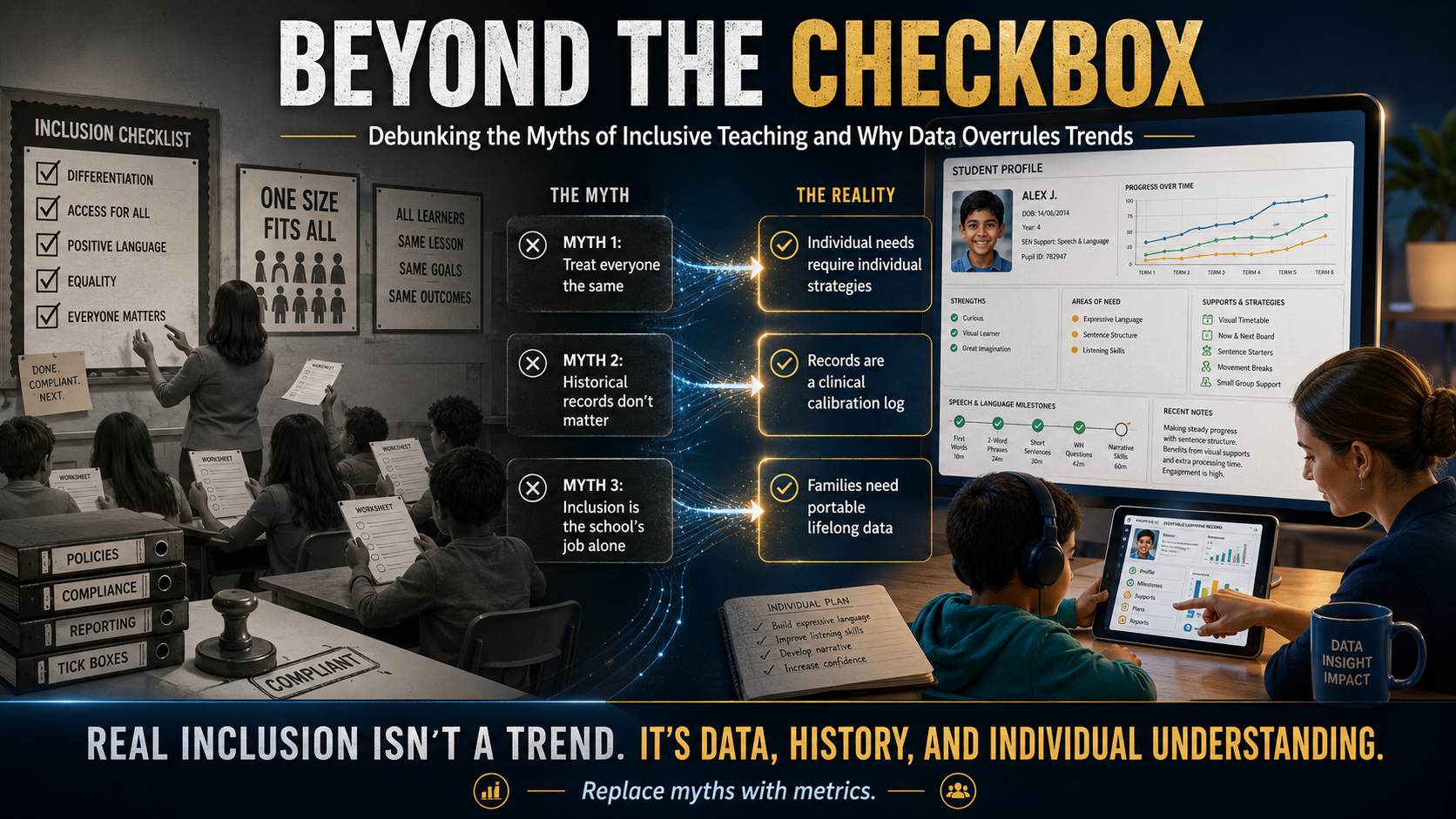
Myth 1: “Inclusive Teaching Means Treating Everyone the Same”
One of the most dangerous myths circulating in modern education is that true inclusion means flattening the landscape so that no child looks “different.” The theory is that if a teacher adopts broad, multi-sensory techniques, every child – whether they have severe dyslexia, ADHD, hypermobility, or speech challenges – will magically rise to the same level without needing distinct, individualized interventions.
The Reality Check: This is a romanticized view of neurodiversity. As we know through epigenetics and neuroplasticity, every brain is adapting to its environment based on a highly specific biological baseline.
A child who needs intensive, early aloud reading and speech therapy to navigate dyslexia cannot simply be swept into a generic “inclusive layout” and expected to thrive. They require targeted, small-group strategies that directly address their internal mechanics. Inclusion without specific, individual data is just guesswork wrapped in a flag of kindness.
Myth 2: “Labels and Historical Records Don’t Matter if the Classroom is Inclusive”
There is a growing school of thought that suggests we rely too heavily on diagnostic “labels” and historical paperwork. The myth implies that if a teacher is doing a good job being inclusive day-to-day, a child’s deep paper trail of early speech therapy assessments, psychological logs, and primary school milestones becomes secondary or even irrelevant.
The Reality Check: This exact myth is what fuels the broken handoff between primary and secondary schools, and ultimately justifies the catastrophic data purge at age 25.
Your childhood records are not rigid, administrative “labels” meant to trap you in a box. They are a clinical calibration log. They record the exact moments your unique mind faced environmental stress and how it adapted. To claim that day-to-day inclusive teaching makes this historical data irrelevant is like telling a mechanic they don’t need the factory diagnostics of a sports car as long as they drive it gently.
Myth 3: “Inclusion is the School’s Responsibility Alone”
The current educational system is built on the myth that the institution is the ultimate custodian of inclusion. Parents are told to trust the system, trust the SEND coordinators, and trust that the school’s internal policies will carry their child through from age 5 to 18.
The Reality Check: As anyone who has transitioned from a supportive primary department to a massive, indifferent secondary school knows, the system forgets.
Schools change staff, budgets get cut, and paperwork gets dropped into bureaucratic black holes. If you leave the blueprint of your child’s mind entirely in the hands of institutional “inclusive policies,” you are gambling with their future self-ownership.
The EdiWay Perspective: Hard Data Over Hollow Myths
We don’t need more generic toolkits or well-meaning myths about inclusive classrooms. We need radical, unfiltered transparency.
True inclusion can only happen when the individual (and their parents) hold the master key to their own developmental history. This is why EdiWay shifts the power dynamic entirely away from institutional trends and back to the family.
-
We don’t rely on a school’s memory: EdiWay creates a permanent, portable digital passport that ensures your specific primary school triumphs, speech milestones, and baseline adjustments move with you, stopping secondary schools from playing the “we didn’t receive the file” card.
-
We replace myths with metrics: When you know exactly what your brain can deliver based on historical proof, you stop being a passive recipient of a school’s “inclusive policy.” You become the active operator of your own mind.
The educational trends will keep shifting, and the myths about inclusion will keep evolving. EdiWay ensures that while the system debates the theories, you keep the hard evidence of who you are.