Another Education Secretary. Another Wave of Reform.
Every new Secretary of State for Education inherits an overflowing in-tray, and this year is no different. Lucy Powell steps into one of the most demanding ministerial roles in government at a time when England’s education system is facing unprecedented pressure. SEND reform, school funding, teacher recruitment and retention, attendance, safeguarding, curriculum change, artificial intelligence, mental health, falling pupil numbers, and accountability all compete for urgent attention.
Each challenge is significant in its own right, but collectively, they represent one of the largest periods of transformation education has experienced in decades. Recent commentary across the education sector has understandably focused on policy priorities: how Ofsted should evolve, how workforce wellbeing can improve, how schools should be funded, and how SEND reforms should be delivered.
While these are important conversations, they expose something much deeper. They reveal a systemic problem that has existed for years, regardless of which political party occupies Westminster: Education policy has become increasingly complex, but the systems supporting it have not kept pace.
Schools Are Not Short of Commitment
Spend just one morning inside any school and one thing becomes immediately obvious: teachers are not lacking commitment, support staff are not lacking compassion, and school leaders are certainly not lacking determination. Across England, professionals arrive early, leave late, and consistently go above and beyond what their contracts require because they genuinely care about improving children’s lives.
Yet, despite this extraordinary dedication, workload continues to rise. Why? Because every new initiative usually arrives with a new process. Another portal. Another spreadsheet. Another reporting framework. Another login and another deadline. Instead of simplifying education, reform often layers new administration on top of the old, leaving a profession spending increasing amounts of time managing systems instead of supporting learners.
The Real Crisis Nobody Talks About
When discussions focus on education reform, attention naturally turns towards funding, inspections, or curriculum. Rarely does anyone ask a far more fundamental question: How many different systems does a school use simply to educate one child?
For many schools, the answer is staggering. A typical pupil’s information may be spread across multiple, disconnected platforms:
-
Management Information Systems (MIS)
-
Attendance and behaviour platforms
-
Safeguarding and SEND management tools
-
Assessment and medical record systems
-
Parent communication apps
-
Finance, HR, and timetabling software
-
Document storage solutions
Every one of these systems serves a purpose, but very few truly communicate with one another. Information is duplicated, staff repeatedly enter identical data, and evidence becomes fragmented. Reports are painfully manual, and data remains isolated. Most importantly, no single person sees the complete story of a child.
Every Reform Depends Upon Better Information
Government policy often focuses on outcomes, but schools must focus on implementation. Take SEND reform as an example. Schools are expected to identify needs earlier, record interventions, monitor progress, work collaboratively with families, share evidence, prepare EHCP reviews, and coordinate with external specialists – all while continuing to teach.
None of these expectations are unreasonable. But delivering them across disconnected software dramatically increases workload. The same applies to safeguarding. A concern recorded today may relate to attendance patterns from six months ago, sudden behaviour incidents, or changes in family circumstances. When these records live in different systems, professionals spend valuable time searching instead of supporting.
Ofsted Doesn’t Create Evidence – Schools Already Do
Inspection has become one of education’s most debated topics. Yet, whether inspection frameworks evolve further or remain unchanged, one fact remains constant: schools already generate vast amounts of evidence every day. Attendance records, behaviour logs, assessment outcomes, safeguarding chronologies, and SEND interventions are continuously happening.
The challenge isn’t producing evidence; the challenge is connecting it. Imagine walking into an inspection with every significant event in a child’s educational journey already organised into one secure timeline – not because staff spent weeks preparing, but because the platform continuously built that evidence every single day. Inspection should be a reflection of excellent daily practice, not a separate, exhausting administrative exercise.
Teacher Wellbeing Begins With Removing Friction
Much has rightly been said about teacher wellbeing, with conversations often centring around resilience, wellbeing programmes, and professional support. While these initiatives matter, an uncomfortable truth remains: no wellbeing strategy can compensate for unnecessary workload.
Teachers do not enter education to complete duplicate data entry. SENCOs do not become specialists to spend evenings copying information between systems. Safeguarding Leads do not train for years simply to search across multiple databases to build a chronology. Technology should remove friction, not create it. Every hour saved through intelligent automation becomes another hour available for teaching, leadership, or family life.
A Connected School Is A Stronger School
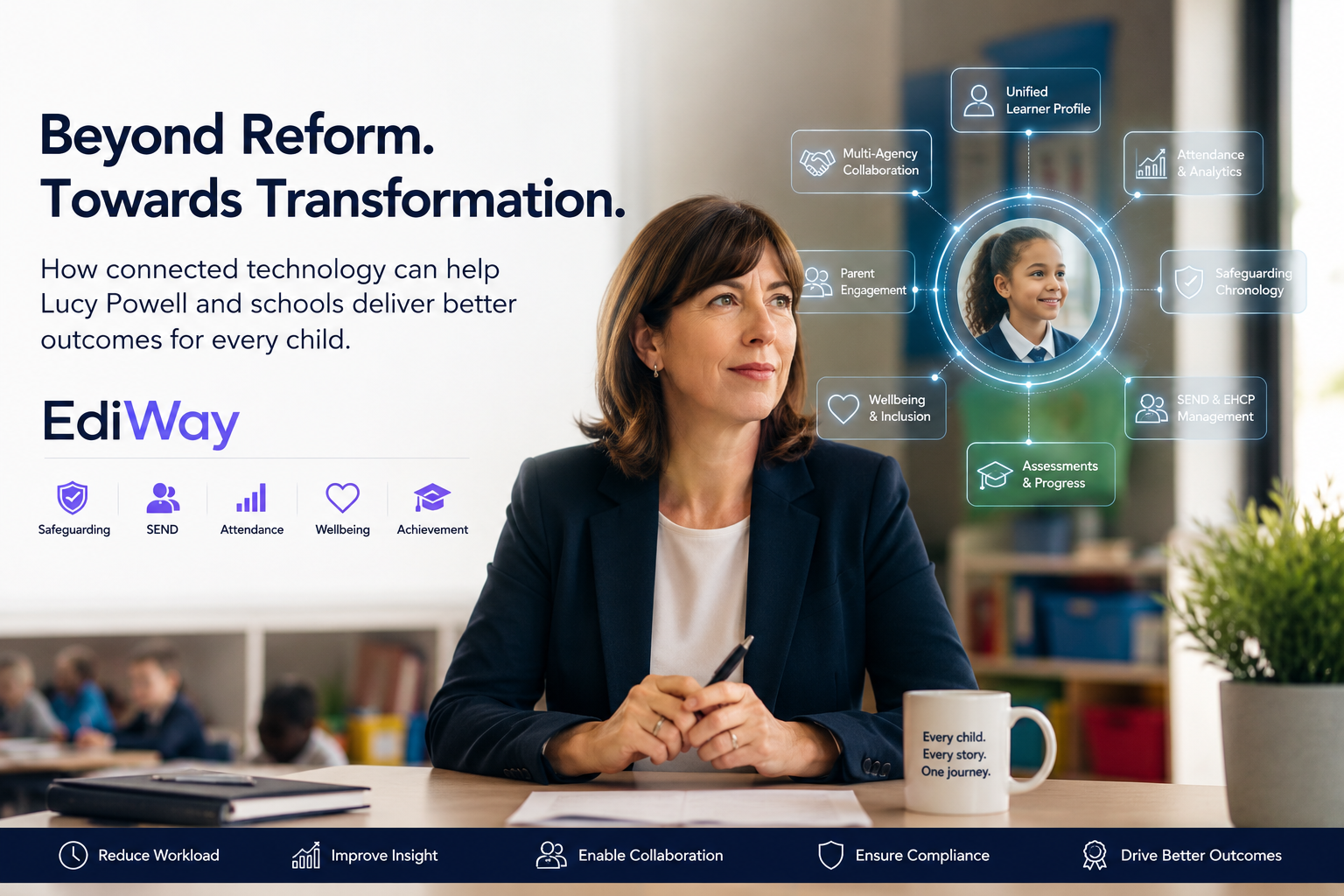
Imagine replacing disconnected software with one intelligent education platform. One learner profile. One secure record. One timeline. One place where attendance, behaviour, safeguarding, SEND, assessments, wellbeing, and parental engagement all work seamlessly together.
This is not about replacing professional judgement; it is about ensuring professionals have the complete picture when making decisions. When attendance begins falling, behaviour incidents increase, and wellbeing check-ins decline, the system should identify patterns before they become crises. Technology should connect education – not fragment it.
The Future Is Intelligence, Not Administration
Artificial Intelligence is rapidly becoming part of the public debate. Some fear it, others overestimate it. Education needs neither extreme. AI should never replace teachers – it should amplify them. Imagine AI helping schools by:
-
Identifying attendance risks before persistent absence develops.
-
Highlighting safeguarding patterns across multiple records.
-
Supporting EHCP documentation and preparing evidence for annual reviews.
-
Identifying behaviour trends and analysing intervention effectiveness.
-
Reducing repetitive administrative tasks and producing leadership reports in seconds.
With AI working in the background, teachers remain entirely responsible for decisions. Technology simply provides better information, faster.
Why EdiWay Was Built Differently
At EdiWay, we asked a simple question: What if schools never had to piece together a child’s educational story again?
Instead of building another standalone application, EdiWay has been designed as a connected education ecosystem where every part of a learner’s journey contributes to one unified record. Its integrated approach combines core MIS functions with a unified learner profile and timeline, AI-assisted attendance insights, safeguarding chronologies, SEND management, EHCP workflows, wellbeing monitoring, and secure collaboration.
Rather than asking staff to move between multiple platforms, EdiWay brings information together. Instead of collecting data purely for compliance, it turns information into meaningful insight. Because education is about children – not databases.
Looking Beyond The Next Parliament
Lucy Powell has inherited one of the most challenging education portfolios in recent history. Her success will depend on policy, investment, and collaboration across the sector. But genuine transformation requires more than legislation. It requires giving schools the practical tools to deliver those ambitions efficiently.
Every new initiative should reduce complexity, not increase it. Every technological investment should save time, not consume it. Every decision should make life easier for teachers and better for learners.
At EdiWay, we believe the future of education is not built upon more disconnected systems. It is built upon one connected platform where every child has a complete educational journey, every professional has the information they need, and every school has the confidence to spend less time on administration and more time changing lives.
When technology finally works with education rather than against it, everybody benefits – teachers, leaders, families, and most importantly, children.