For neurodivergent individuals with a PDA (Pathological Demand Avoidance / Pervasive Drive for Autonomy) profile, everyday life can feel like walking through a minefield of invisible threats. PDA is increasingly recognized within the autism spectrum not as a behavioral choice or a form of defiance, but as an intense, anxiety-driven neurodevelopmental response to a perceived loss of autonomy.
When a standard request is made, a PDA brain doesn’t hear a simple question; it registers a direct threat to its safety, instantly triggering a survival response (fight, flight, freeze, or fawn).
To truly support someone with a PDA profile, we have to fundamentally rewrite our understanding of what constitutes a “demand” and shift from a culture of compliance to one of collaboration.
The Hidden Spectrum of “Demands”
Most people think of demands as commands: “Clean your room,” or “Turn off the TV.” But for a PDA individual, demands are far more pervasive and insidious. They can be broken down into three distinct categories:
-
Direct Demands: Explicit expectations or instructions from other people (“Please sit down,” or “Write your name here”).
-
Indirect/Implicit Demands: Unspoken expectations, social norms, time constraints, or even transitions from one activity to another.
-
Internal Demands: This is often the hardest for neurotypicals to grasp. A demand can come from inside the person’s own body. Biological needs (like feeling hungry, needing to use the restroom, or feeling tired) can trigger demand avoidance. Even things the person wants to do – like playing their favorite video game or going to a party – can register as a demand because of the expectation of performance or transition.
The PANDA Framework: A Deeper Look with Practical Shifts
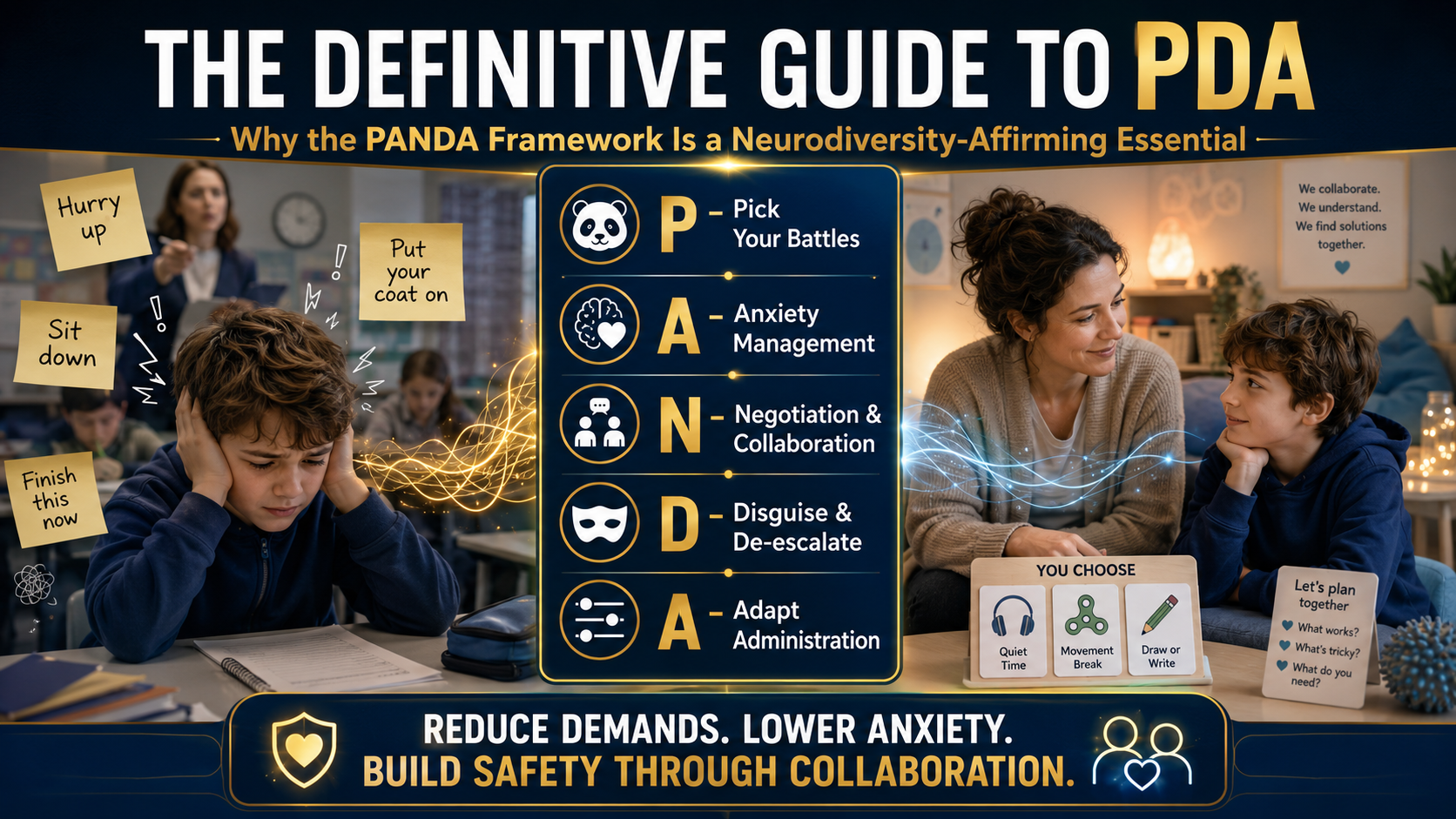
Developed by the PDA Society, the PANDA framework shifts the focus away from trying to “fix” the avoidance and toward managing the underlying anxiety.
Let’s break down each element with practical, real-world applications.
🐼 P – Pick Your Battles
With PDA, the total volume of demands is cumulative. Think of it like a “stress bucket” – every demand adds water to the bucket. If you don’t minimize everyday expectations, the bucket overflows into a meltdown.
-
The Shift: Audit the day. Ruthlessly eliminate non-essential demands. Does it actually matter if they wear mismatched shoes, eat cereal for dinner, or do their schoolwork while lying upside down on the couch?
-
The “Why” Factor: PDA individuals have a profound need for equality and logic. Never use the phrase “Because I said so.” If a demand is genuinely necessary (such as a safety rule), explain the objective rationale for it.
🐼 A – Anxiety Management
PDA is, at its core, a chronic state of nervous system overload. When a PDA individual says “no,” throws an object, or completely freezes, they are not being manipulative – they are drowning in adrenaline.
-
The Shift: Stop viewing behavior through the lens of discipline. Punishments, charts, and rewards only increase the pressure and skyrocket anxiety.
-
Co-Regulation: Your calm is their anchor. Lower your pitch, slow your speech, and give them physical space. Focus entirely on rebuilding a sense of safety before you ever try to address what happened.
🐼 N – Negotiation and Collaboration
Because autonomy is as essential to a PDA individual as oxygen, they must feel like an equal partner in their own life. A top-down hierarchical relationship will constantly trigger their threat response.
-
The Shift: Move from dictating to collaborating. Treat them as a consultant in solving the problem.
-
The Power of Choice: Instead of forcing a single path, offer choices where both outcomes are acceptable. Ensure these choices are genuine and not veiled threats (e.g., “You can do your chores now or lose your iPad” is not a choice; it’s a demand with a penalty).
🐼 D – Disguise and De-escalate
Direct language hits the PDA brain like a physical blow. By changing how we phrase things, we can bypass the subconscious threat detector and keep the thinking brain online.
-
The Shift: Change your vocabulary. Swap out imperative verbs for invitational, declarative language.
| Instead of saying… | Try saying… |
| “Put your coat on right now, we are leaving.” | “I noticed it’s freezing outside today. I’m putting my coat on.” |
| “You need to finish this worksheet.” | “I wonder how we could tackle this problem. It looks tricky.” |
| “Come to the dinner table.” | “Food is on the counter for whenever anyone is ready to eat.” |
| “Stop doing that.” | “I’m worried that might break, let’s see if we can find a safer way.” |
-
Inject Novelty and Humor: The threat response cannot coexist with genuine laughter. Turning a transition into a roleplay, using a funny voice, or making a silly bet can completely de-escalate a tense moment.
🐼 A – Adapt Administration
A support plan for a PDA individual cannot be rigid. What worked seamlessly on Tuesday might cause a total meltdown on Wednesday because their baseline anxiety level has changed.
-
The Shift: Become infinitely flexible. Constantly read their micro-expressions and body language. If you see signs of masking or escalating stress, seamlessly pivot and drop the demand.
-
The “Get-Out” Clause: Paradoxically, a PDA individual is much more likely to try something new if they know they have a safe, unconditional exit strategy. Knowing they can leave a party, drop a class, or stop a task at any moment lowers the invisible pressure cooker enough to let them try.
The Reality of “Masking” and the Spillover Effect
A crucial concept to include in any discussion about PDA is masking. Many PDA individuals – especially in school or workplace environments – will exert an immense amount of energy to comply with demands to blend in or avoid conflict.
To an outside observer, they might look like they are coping perfectly. However, this comes at a massive internal cost. When they return to their “safe space” (usually home), the accumulated pressure explodes in what is known as the spillover effect. Understanding masking is vital so that parents, educators, and professionals don’t misinterpret home-based meltdowns as a parenting failure or selective behavior.