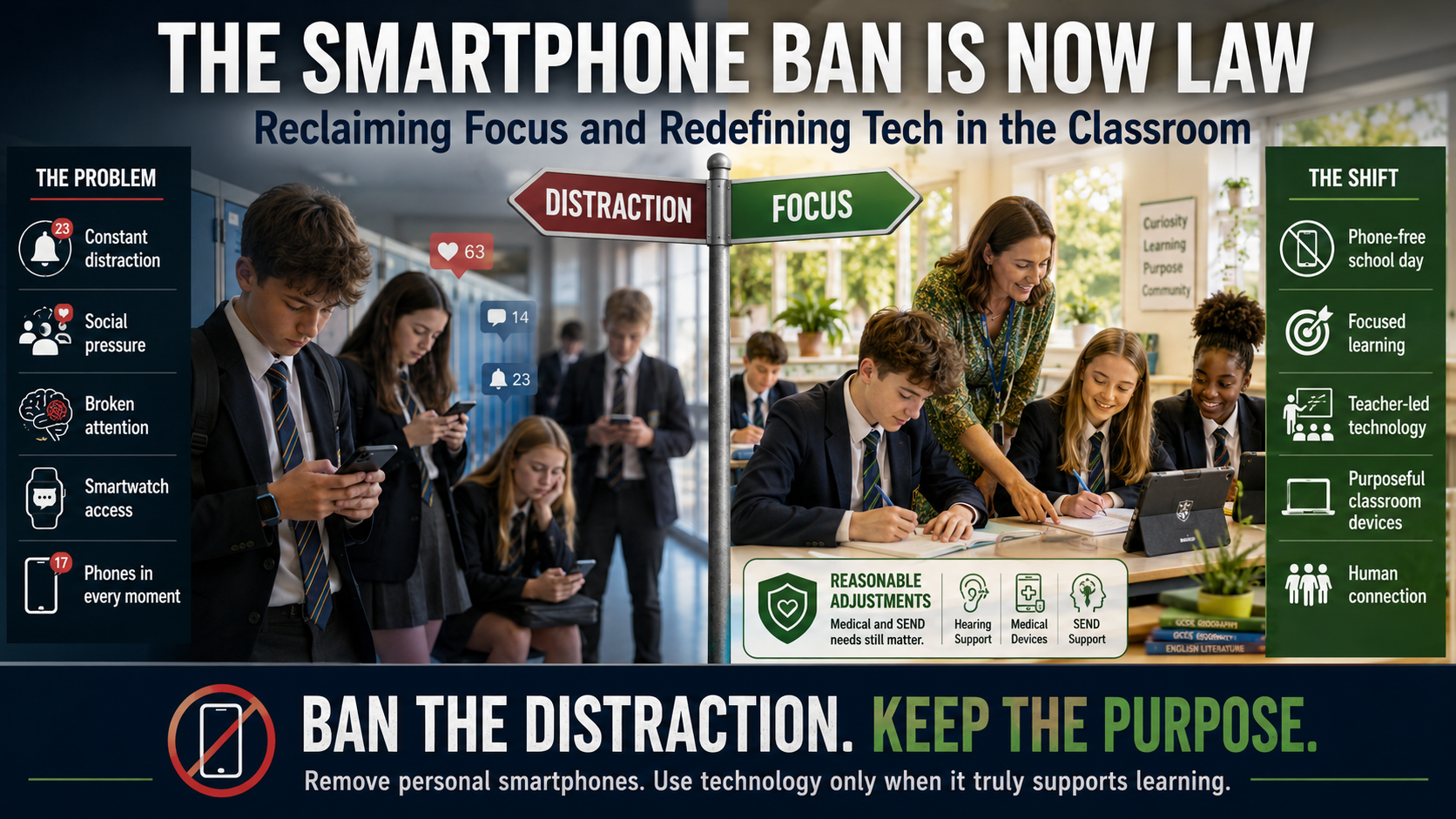
As of, Monday, June 29, 2026, the long-standing debate over mobile phones in schools is officially settled. Under Section 36 of the Children’s Wellbeing and Schools Act 2026, the government’s guidance has transitioned into a legally enforceable mandate across England. The law is explicit: pupils must not have access to mobile phones – or similar smart devices, including smartwatches – throughout the entire school day.
This restriction leaves no room for ambiguity. It spans the entirety of the school day, covering lessons, transition times between classes, break times, and lunchtimes. Passive “not seen, not heard” approaches are no longer legally compliant. Furthermore, Ofsted inspectors are now required to formally evaluate how consistently and effectively schools enforce these phone-free environments.
How Schools Are Adapting
While the legal mandate is strict, schools retain the autonomy to implement the ban using a model that best fits their specific community. Most institutions are currently leaning into one of three distinct approaches:
-
The Total Ban: Devices are strictly prohibited from entering school premises entirely.
-
The Morning Hand-In: Pupils hand over their devices at registration, and they are stored securely until the final bell.
-
The Locker/Bag Rule: Mobile phones must remain powered off completely and stored away in lockers or backpacks, never to be accessed during the day.
Importantly, the legislation incorporates common-sense boundaries. Older students in Years 12 and 13 may be granted device access within designated sixth-form areas, provided they are not utilized in sight of younger pupils.
Navigating Reasonable Adjustments: The SEN and Medical Framework
Crucially, the statutory phone ban cannot be applied as a rigid, blanket rule. Under the Equality Act 2010 and the Children and Families Act 2014, schools have a strict legal duty to make “reasonable adjustments” to ensure students with disabilities, special educational needs (SEND), or complex medical conditions are not left at a disadvantage.
In practice, this means students who rely on continuous glucose monitors for Type 1 diabetes, heart-rate trackers, or assistive communication apps (such as text-to-speech tools for selective mutism or visual impairments) must retain access to their devices.
To manage this without disrupting the phone-free environment for the rest of the student body, the guidance recommends that schools formalise these exceptions directly within a pupil’s Individual Education Plan (IEP). Many institutions are successfully handling this by issuing discrete “exemption passes” or slips. This allows staff to instantly verify a pupil’s permission to use a device, while clear boundaries ensure the phone is only accessed for its specific medical or supportive purpose rather than general distraction.
Distinguishing Distraction from Purposeful EdTech
As we remove personal smartphones from the equation, it is vital to clarify the role of digital devices used specifically for lesson learning within the classroom.
Banning smartphones does not mean abandoning technology. Where schools utilise laptops, tablets, or managed Bring Your Own Device (BYOD) schemes to facilitate interactive learning, these tools remain vital. The critical distinction lies in control and intent. A school-managed tablet used to complete a coding exercise or access an online assessment operates under strict educational parameters. It is entirely free from the unregulated, algorithmic pull of social media notifications, instant messaging, or infinite scrolling.
However, embracing in-class devices still requires a highly critical eye. As we recently explored in our feature, Screen Time vs. Spelling: The EdTech Backlash in Primary Schools, educators and parents alike are increasingly questioning the overall saturation of screens in early education.
A Holistic Approach to a Digital Diet
The newly enforced phone ban and the growing primary EdTech backlash are fundamentally two sides of the same coin. Both stem from a collective, societal realisation that unmanaged screen time chips away at children’s attention spans, distracts from deep cognitive learning, and significantly impacts mental well-being.
The Core Risk: When foundational skills – like traditional handwriting and phonetic spelling – take a back seat to gamified learning apps, the long-term educational foundation weakens.
The new smartphone law reinforces the need for schools to be highly intentional about when and how children interact with screens. By eliminating the constant background distraction of personal mobile phones, classrooms can once again become spaces of focused, human-to-human engagement.
This policy shift gives teachers the necessary breathing room to deploy technology only when it genuinely enhances a lesson—ensuring that when screens are turned on, they are actively building skills, not replacing them.