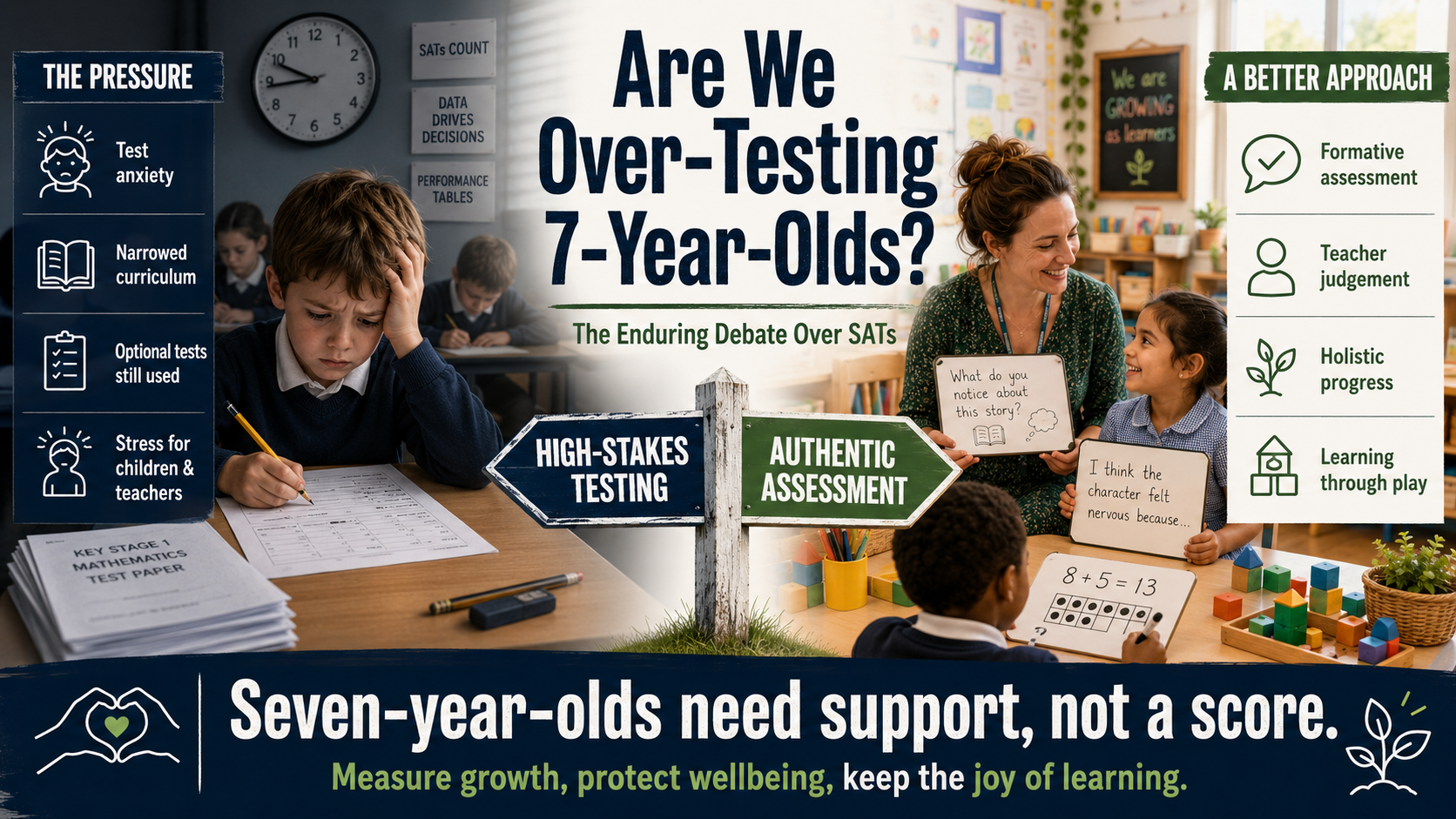
Every year, across the country, thousands of seven-year-olds are put through a process that causes significant, unnecessary stress for children, parents, and teachers: Key Stage 1 SATs. Historically, the month of May has been synonymous with intense anxiety in British primary schools. Children who only a few years prior were learning through play and free exploration in the Early Years Foundation Stage (EYFS) are suddenly thrust into a highly structured, pressurised environment. They are asked to sit silently, navigate complex test papers, and prove their worth in reading comprehension, grammar, punctuation, spelling, and arithmetic.
However, the educational landscape is shifting. The question is no longer whether we are over-testing; the question is, why do we continue to prioritise a narrow, snapshot measure of attainment over the holistic, developmental progress of the child? Despite recent national policy changes aimed at reducing the assessment burden, a deeply entrenched culture of high-stakes testing continues to cast a long, restrictive shadow over early childhood education. To dismantle this culture, we must deeply examine the psychological cost of early testing, the inherent unfairness to neurodivergent learners, and the urgent need for a transition toward authentic, continuous assessment frameworks.
The Policy Shift: Optional vs. Abolished
To understand the current crisis in early primary assessment, one must navigate the recent, somewhat contradictory shifts in UK educational policy. For decades, the End of Key Stage 1 assessments – commonly known as SATs – were statutory. Every state-funded primary school in England was legally mandated to test their Year 2 pupils and report the data to local authorities and the Department for Education (DfE).
In a victory for educational campaigners, child psychologists, and teaching unions like the National Education Union (NEU), the government finally conceded that the testing burden was too high. Consequently, Key Stage 1 SATs were made non-statutory from the academic year 2023 to 2024. Furthermore, the Standards and Testing Agency announced that they would no longer print and distribute KS1 test papers to schools in England from the academic year 2024 to 2025.
On paper, this sounds like the definitive end of the Year 2 SATs. In practice, the reality is far more complex.
Many schools, driven by the intense pressures of Ofsted inspections, Multi-Academy Trust (MAT) data demands, and the desire to establish rigorous baseline metrics before students transition into Key Stage 2, have chosen to retain the tests. They utilise past papers, purchase “shadow tests” from commercial educational suppliers like NFER, and maintain the exact same high-stress testing environments under the guise of “optional internal assessments.” The legal mandate may have been abolished, but the institutional anxiety driving the testing culture remains entirely intact. For the seven-year-old sitting in a silent hall staring at a complex reading comprehension booklet, it makes absolutely no difference whether the test is statutory or optional; the stress is identical.
The Psychological Impact of Early Testing
At seven years old, a child’s confidence is still fragile. Developmentally speaking, a Year 2 student is just beginning to transition from the preoperational stage of cognitive development to the concrete operational stage. Their understanding of the world is largely tied to physical, tangible experiences, social interactions, and imaginative play. Their self-concept – how they view themselves in relation to their peers and their teachers – is highly malleable and deeply sensitive to external validation.
Introducing high-stakes, formal testing at this age is a direct, measurable risk to the child’s emerging sense of themselves as a learner. When we place a young child in a high-pressure assessment scenario, we are triggering acute cognitive and emotional overload. Educational psychologists consistently note that “test anxiety” in early primary education manifests in severe physical and emotional symptoms. Parents frequently report their seven-year-olds experiencing sleep disruptions, night terrors, uncharacteristic emotional outbursts, stomach aches, and instances of school refusal directly linked to the pressures of “Assessment Week.“
Furthermore, the existence of these tests forces a devastating “narrowing of the curriculum.” Because teachers are held accountable for their students’ performance in English and mathematics, a disproportionate amount of the school timetable is dedicated to rote learning, phonics drills, and arithmetic practice. Subjects that foster creativity, physical well-being, and broader cultural capital – such as art, music, drama, physical education, and geography – are quietly marginalised to make way for test preparation. A system that sacrifices a child’s holistic development to coach them through a narrow standardised test is fundamentally failing its students.
The Neurodivergent Experience and the Deficit Model
If standardised testing is damaging for the neurotypical child, it can be entirely destructive for those with Special Educational Needs and Disabilities (SEND). For those with neurodivergent profiles, the experience can be traumatic, reinforcing a “deficit model” of education that equates their worth with a test score.
Standardised assessments are built on the assumption of a standardised brain, which simply does not exist. Consider the inherent barriers a Key Stage 1 SAT paper presents:
-
Attention Deficit Hyperactivity Disorder (ADHD): A child with ADHD may possess extraordinary verbal reasoning skills and lateral problem-solving abilities, but sitting silently at a desk to complete a 40-minute written paper runs entirely counter to their neurological wiring. Their test score will reflect their inability to sustain stationary focus, not their actual intelligence or understanding of the subject matter.
-
Autism Spectrum Condition (ASC): Autistic learners often interpret language very literally. The slightly ambiguous or overly wordy phrasing frequently found in standardised mathematics reasoning papers can cause immense confusion and subsequent meltdowns. The child understands the math, but they are tripped up by the neurotypical social phrasing of the question.
-
Dyslexia and Processing Differences: For a child with emerging dyslexia, the high-pressure demand to decode complex texts under time constraints induces a state of “fight or flight.” When the brain is in an autonomic panic state, higher-order cognitive processing shuts down.
When a neurodivergent child inevitably struggles with a format designed against their neurology, they are assigned a label – often “Working Towards the Expected Standard.” This label is a core component of the deficit model. It tells the child, their parents, and their future teachers what the child cannot do, rather than celebrating what they can do. Early, repeated exposure to this type of systemic failure teaches neurodivergent children that education is an arena where they cannot win, paving the way for long-term school disengagement.
Moving Toward Authentic Assessment
The answer to ‘are we over-testing’ is not to eliminate all assessment; it is to shift toward assessment that is continuous, meaningful, and genuinely useful for the child. Schools need to be able to track genuine development without the artificial stress of a formal, high-stakes exam.
The alternative to the snapshot standardised test is formative assessment. Formative assessment is the ongoing, low-stakes practice of gathering information about a student’s learning during the learning process, allowing the teacher to adjust their instruction in real-time. Instead of waiting until May to find out a child does not understand fractions, a teacher utilising formative assessment knows immediately.
Effective formative assessment in a Year 2 classroom looks completely invisible to the child. It includes:
-
Low-Stakes Mini-Whiteboard Quizzes: Children hold up their answers to a quick math problem, allowing the teacher to see the entire room’s comprehension at a glance without a single mark going into a formal grade book.
-
Diagnostic Questioning and Discussion: Assessing a child’s reading comprehension not by making them write an essay, but by sitting with them and having a genuine conversation about the book they are reading.
-
Observational Assessment: Watching a child solve a problem in the sandpit, build a complex structure with blocks, or resolve a conflict with a peer, and mapping those behaviours to developmental milestones.
By relying on professional, evidence-based teacher judgment rather than externally marked papers, we return agency to the educators who actually know the children. The DfE’s own updated guidance on optional Key Stage 1 teacher assessment highlights that day-to-day formative assessment should be the primary vehicle used to inform teaching on an ongoing basis. It is time for school leadership teams to trust their teachers to assess, rather than relying on the crutch of a standardised paper.
Deploying EdiWay: The Architecture of Authentic Tracking
While the philosophy of formative assessment is universally praised, the logistical reality of tracking continuous, observational data for a class of thirty 7-year-olds can be an administrative nightmare for teachers. Without the right tools, moving away from a single SAT paper means drowning in sticky notes, disorganised spreadsheets, and endless weekend paperwork.
This is where digital infrastructure bridges the gap between pedagogical theory and classroom reality. EdiWay offers this shift, providing an operational framework that focuses on the whole child. Designed to dismantle educational data silos, EdiWay acts as a comprehensive digital spine for the modern primary school, turning continuous assessment from a burden into a seamless workflow.
EdiWay empowers educators to:
-
Track Holistic Milestones: Document development in social, emotional, and cognitive areas, ensuring that the ‘whole child’ is valued, not just a score on a standardised test. Using EdiWay’s intuitive mobile interfaces, a teacher can instantly log an observational milestone – such as a child demonstrating leadership during a group art project or finally grasping the concept of sharing – with a quick tap. This ensures that vital “soft skills” and emotional intelligence metrics are weighed equally against traditional academic achievements.
-
Generate Evidence of Progress: Provide a rich, longitudinal picture of the child’s development, which is far more meaningful and actionable than a single snapshot. The platform aggregates daily formative inputs, diagnostic quiz results, and observational notes into a highly visual, easy-to-read dashboard. When school leaders or Ofsted inspectors request data on pupil progress, the school does not need to point to a stressful May test; they can point to a robust, data-rich longitudinal profile that maps exactly how the child has grown over the past 190 school days.
-
Reduce Test-Related Anxiety: Create an environment where assessment is a natural, ongoing part of learning, rather than an intrusive, high-pressure event. Because EdiWay allows teachers to capture data invisibly in the background of normal classroom activities, the children are never subjected to the trauma of an exam hall. Furthermore, the platform’s Parent Portal allows for transparent, real-time sharing of these positive milestones with families, eliminating the anxious build-up to an end-of-year report card or test result letter.
By integrating a platform like EdiWay, schools are given the technological confidence they need to officially abandon optional standardised tests. They are provided with the irrefutable evidence required to prove that a child is learning, growing, and thriving, without ever having to subject that child to an exam.
We stand at a critical crossroads in early childhood education. We have the pedagogical research, the governmental policy shifts, and the technological tools required to end the culture of high-stakes testing for our youngest learners. Yet, the final barrier is institutional bravery. School leaders and Multi-Academy Trusts must possess the courage to step off the standardised treadmill, reject the pressure to run “optional” SATs, and embrace a model of education that prioritises well-being over raw data extraction.
Seven-year-olds should be defined by their curiosity, their resilience, and their budding interests – not by how they performed on a standardised test. A child is infinitely more complex, capable, and valuable than a score out of forty on a reading comprehension paper.
By utilising EdiWay To track genuine development, we can ensure that schools stay focused on what matters: the long-term, holistic, and unique success of every child. It is time to let seven-year-olds be seven-year-olds and return the joy, breadth, and discovery to the primary classroom.
References & Online Resources
-
Department for Education (GOV.UK): Optional key stage 1 teacher assessment guidance 2024-2026. Provides full guidance on the shift to optional assessments and the prioritisation of formative teacher assessments. Link
-
National Education Union (NEU): KS1 and KS2 SATs Policy and Campaign. Outlines the NEU’s stance on the abolishment of mandatory KS1 tests and the negative impact of testing on SEND pupils. Link
-
National Foundation for Educational Research (NFER): Enhancing opportunities for formative assessment in primary maths. Detail pedagogical strategies for continuous, low-stakes assessment alternatives. Link
-
EdiWay Official Platform: Information regarding unified operational architecture for schools, holistic milestone tracking, and the integration of continuous assessment dashboards. Link