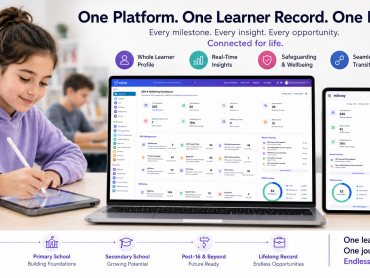
Education changes around the learner. Their history, needs, strengths and progress should not have to start again each time it does.
A learner can move through many different educational contexts.
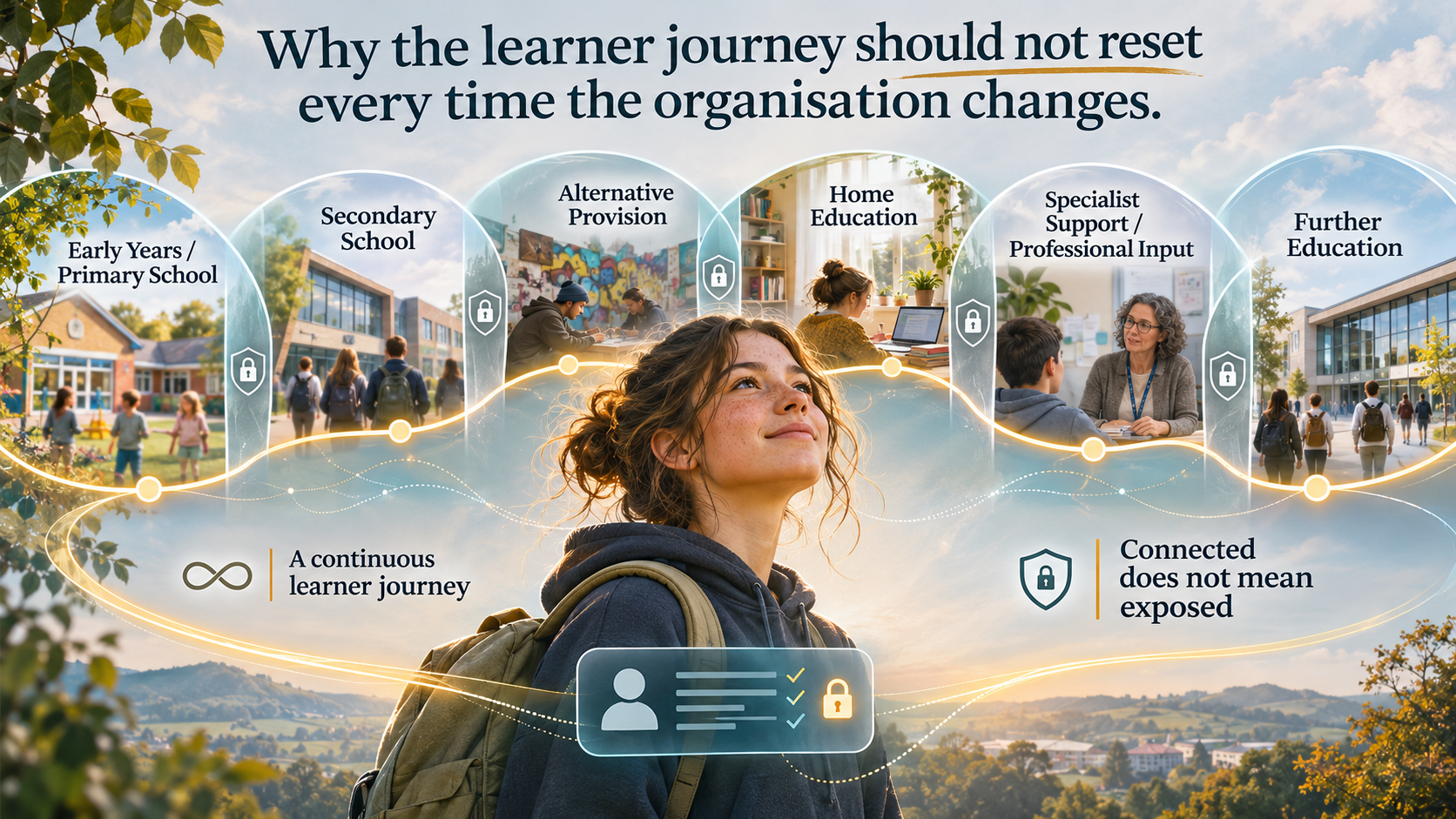
They may begin in an early years setting, move into primary school, transfer to secondary school, spend time in alternative provision, receive specialist support, move into Home Education, return to a school, receive support from outside professionals and later progress into further education.
The organisations around them may change several times.
The learner does not.
Yet many education systems are still organised as though the institution is the permanent centre of the journey.
A child arrives.
A record is created.
The school builds up information about that learner.
Then the child leaves.
Another organisation starts its own record, imports some information, requests other documents and tries to understand what happened before.
Some information transfers successfully.
Some arrives as a PDF.
Some arrives as a spreadsheet.
Some remains in a previous system.
Some sits in emails.
Some relies on somebody remembering to send it.
Some of the most important context may exist only in the knowledge of the people who previously supported the child.
The result is not necessarily a complete loss of information.
It is something more subtle.
It is a loss of continuity.
The learner journey is longer than any individual organisation
Schools understandably need systems designed around their responsibilities.
They need attendance registers, timetables, assessments, safeguarding processes, SEND records, staff information, reporting and many other operational functions.
But the learner’s educational journey does not begin and end with one school’s database.
Consider a learner who moves through:
mainstream school → alternative provision → Home Education → another school → further education
There may be legitimate records in every one of those contexts.
Each organisation may need to retain its own historical information.
The family may hold information of its own.
External professionals may contribute evidence for a particular purpose.
Some records may be highly sensitive.
Some should move with the learner.
Some should not.
The challenge therefore is not simply:
“How do we transfer all of the data?”
The better question is:
How do we maintain meaningful continuity without turning the learner into a universally visible record?
That distinction matters.
Continuity should not mean unrestricted access
One possible response to fragmented education records would be to create a giant central record that every authorised organisation can search.
That might appear to solve the continuity problem.
But it creates another one.
Being connected to a learner does not necessarily mean an organisation should see everything ever recorded about them.
A classroom teacher may need to understand an adjustment that helps a learner participate successfully.
That does not mean they need every underlying specialist report.
A receiving school may need current educational information when a child transfers.
That does not automatically mean it should inherit every historical family note.
A professional working with a learner for a defined purpose may need particular evidence.
That does not mean they should gain standing access to the learner’s complete school record.
A trust may need to understand performance and operational patterns across its schools.
That does not mean trust membership should automatically provide access to every individual learner record.
This leads to a principle I think education technology needs to take much more seriously:
Connected does not mean exposed.
Continuity and privacy should not be treated as opposing ideas.
A well-designed system should be able to support both.
The problem with copying records
Education technology has traditionally dealt with transitions through transfer.
One system exports information.
Another imports it.
That is necessary in many circumstances and will remain important.
But copying data alone does not solve the deeper problem.
Once information has been copied, several questions appear.
Which version is authoritative?
Who created the information?
Was it a school observation, a family observation or a professional opinion?
When was it true?
Has it subsequently changed?
Was the receiving organisation supposed to receive the whole record or only part of it?
If the original information is corrected, what happens to the copied version?
What should happen when the relationship with the receiving organisation ends?
And what happens when the learner moves again?
Over time, the same learner can become represented by a series of partially overlapping records.
The issue is no longer simply duplication.
It is loss of context.
Provenance matters
Imagine that three people make observations about the same learner.
A parent says the learner becomes exhausted after particular activities.
A teacher says the learner participates well during the school day.
A specialist professional records that further observation would be useful.
Those statements are not necessarily contradictory.
They come from different people, in different contexts, for different purposes.
A good learner record should not flatten them into one supposedly objective statement.
It should retain:
- who contributed the information;
- the context in which it was contributed;
- when it was relevant;
- what purpose it served;
- whether it was observation, professional opinion or formal decision.
That is what allows future professionals to interpret evidence properly.
Continuity should preserve meaning, not simply data.
Transitions are where fragmentation becomes visible
Transitions are often the moment when weaknesses in our information systems become obvious.
A new school wants to understand:
- what has helped this learner;
- what support is currently in place;
- what has already been tried;
- where there are gaps;
- what the learner thinks;
- what the family thinks;
- what needs immediate attention.
The information may technically exist.
The difficulty is finding it, understanding it and determining what remains current.
This can create unnecessary repetition.
Families repeat their history.
Learners explain themselves again.
Professionals request information another professional has already gathered.
Schools reconstruct support arrangements that were already understood elsewhere.
Teachers spend time searching documents instead of supporting the learner.
The administrative cost is important.
The human cost is more important.
For a learner who has already experienced a difficult transition, being repeatedly asked to start again can make the system itself feel discontinuous.
Home Education exposes the limitation particularly clearly
Home Education is a useful example because it challenges the assumption that education always belongs inside a school record.
If a learner becomes home educated, their educational journey has not stopped.
Their learning continues.
Their interests develop.
They may produce work, pursue projects, gain knowledge, attend groups, use online resources and build evidence of progress.
That activity should not need to be represented as a fictional school enrolment merely so a system knows where to put it.
Similarly, if that learner later returns to school, their Home Education history should not automatically disappear.
Nor should the new school automatically own everything the family created during that period.
What is needed is a way of recognising that:
the learner is continuous even when the educational context changes.
The authority surrounding different information may change.
The identity of the learner should not need to.
The same issue appears in alternative provision
Alternative provision, EOTAS and multi-agency support create similar challenges.
Several organisations may legitimately contribute to one learner’s education.
One organisation may remain responsible for part of the learner’s provision while another delivers support.
A professional may need access for a defined case.
A family may contribute information.
A school may need to review progress.
A local authority may need evidence for a statutory or commissioning purpose.
The wrong answer is to assume that everybody involved should see everything.
The other wrong answer is to keep everyone in completely separate information silos.
The better model is controlled collaboration around a continuous learner journey.
A learner-centred system changes the starting question
Traditional systems often begin with:
Which school does this pupil belong to?
A learner-centred model begins with:
Who is this learner, what is their current educational context, and who is authorised to act in relation to them for this purpose?
That sounds like a small change.
It is not.
It changes how we think about:
- transitions;
- Home Education;
- alternative provision;
- family contributions;
- professional involvement;
- historical evidence;
- data portability;
- privacy;
- organisational boundaries.
The organisation remains important.
But it becomes part of the learner’s journey rather than the sole container for it.
Continuity should not erase organisational responsibility
A learner-centred system does not mean every organisation writes into one undifferentiated record.
Schools still need to own their own records.
Families should retain appropriate ownership of information they create.
Professionals should remain identifiable as the source of their contributions.
Local authorities may hold records for purposes that are different from those of a school.
Historical responsibility should remain visible.
The goal is not to erase boundaries.
It is to make those boundaries work together.
That distinction is important because education data is not merely information.
It also represents responsibility.
Who made a decision?
Who observed something?
Who approved an action?
Who was responsible at that point in time?
Who is responsible now?
A system that merges everything together can lose those answers.
The learner should not have to pay for organisational change
This is ultimately the principle that matters most.
Changing organisation should not unnecessarily mean:
- losing useful evidence;
- repeating assessments;
- reconstructing history;
- restarting support conversations;
- losing learner voice;
- losing family context;
- losing recognition of previous learning;
- becoming invisible between systems.
Sometimes reassessment is necessary.
Sometimes information should not transfer.
Sometimes a fresh start is beneficial.
The point is that those should be deliberate decisions.
They should not happen accidentally because one database ended and another began.
What better continuity could look like
A better model would allow a learner’s journey to remain understandable over time while still respecting the authority of each organisation and individual involved.
It would recognise that:
identity can continue without universal visibility.
history can remain available without becoming universally searchable.
information can be shared without transferring ownership of everything.
family evidence can remain family-attributed.
professional evidence can remain professional-attributed.
one organisation ending its relationship with a learner should not erase what happened there.
And:
a future organisation should receive what it legitimately needs, not automatically everything that exists.
This is the distinction between building a larger database and building genuine continuity.
Questions worth asking of education technology
When schools, trusts, local authorities or policymakers think about the next generation of education systems, I think some useful questions are:
- What happens to a learner’s history when they change setting?
- Does continuity depend entirely on exporting and importing files?
- Can information retain its original source and context?
- Can families contribute evidence without automatically giving it to every future organisation?
- Can outside professionals collaborate without gaining unrestricted access?
- Can Home Education exist as a genuine educational context rather than a workaround?
- Can a learner move between different forms of education without repeatedly becoming a new record?
- Can systems preserve continuity while still respecting privacy?
Those are not simply technical questions.
They are questions about how we choose to organise education around the people it is supposed to serve.
A different starting point
For me, the starting principle is simple:
The learner journey should be continuous even when the organisations around it change.
That does not require every organisation to know everything.
It does not require one organisation to own the learner’s entire history.
And it certainly does not require privacy to be sacrificed for interoperability.
It requires us to stop treating organisational boundaries as the same thing as learner boundaries.
Because schools change.
Professionals change.
Educational arrangements change.
The learner continues.
And our systems should be capable of recognising that.