If you want to test the absolute limits of a high-energy child’s focus, place them in a standard, bustling classroom of thirty pupils and ask them to absorb a rigid, linear lesson. For a brain wired for constant momentum, that environment can quickly become overwhelming.
But for many who grew up in the 1990s and 2000s, the story didn’t end there. Forward-thinking primary schools often recognised when a child needed a different space to thrive. Many of us remember the distinct pivot of being lifted out of the main classroom noise and placed into a dedicated special needs department – a tight-knit, focused sanctuary of just six or seven children.
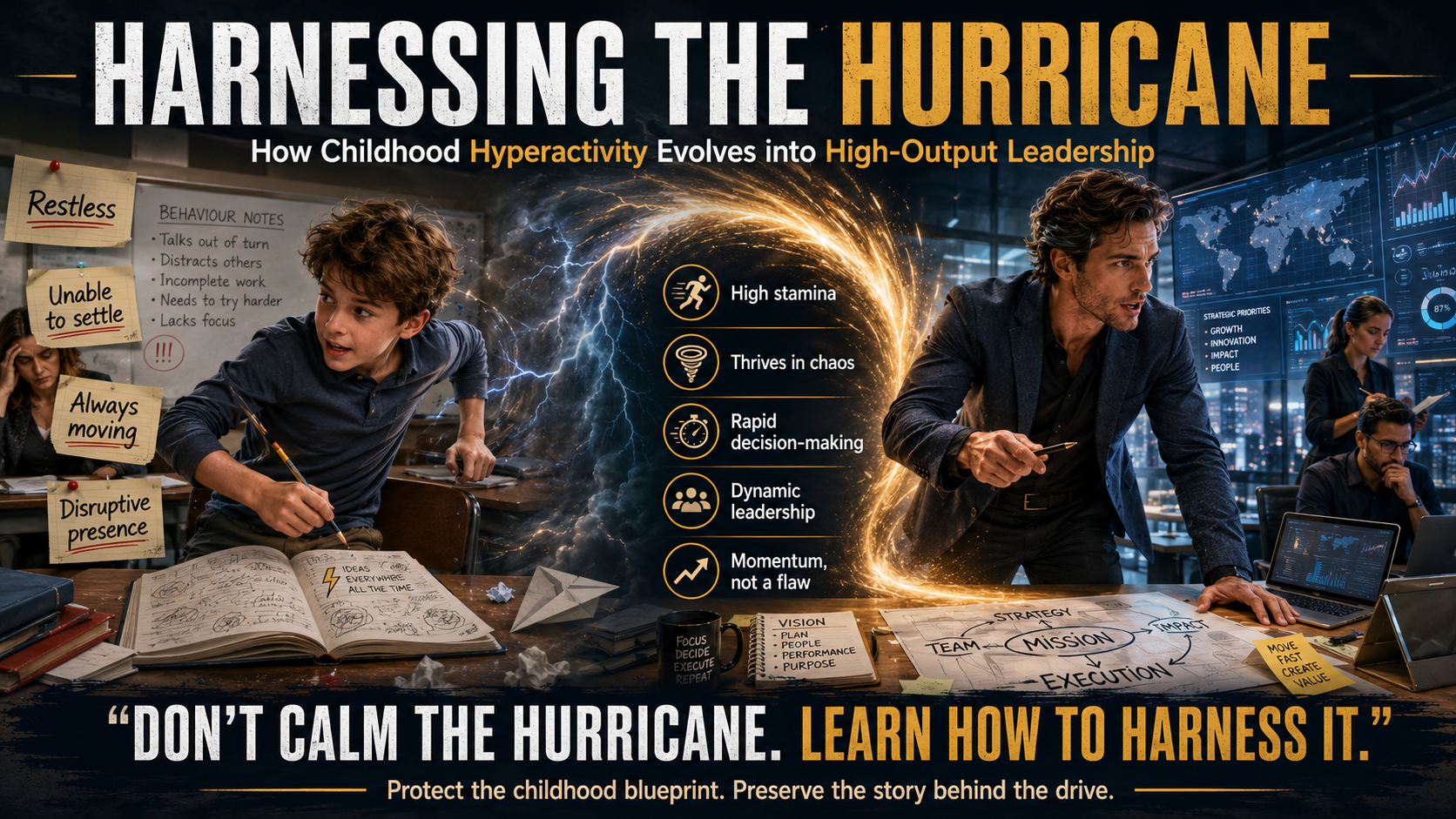
In those smaller spaces, educators could actually see the child behind the behavior. Yet, even with that vital recognition, standard school reports still had to log the raw mechanics of a high-energy mind: labels like “restless,” “unable to settle,” or “constantly fidgeting.”
The primary school’s job was to help calm the waters so we could learn. But as we look at the fast-paced, high-stakes world of modern business, startup culture, and crisis management today, the narrative completely flips. The adult world doesn’t run on static compliance – it runs on momentum. And those childhood “hurricanes” who were spotted and supported early on are exactly the individuals driving industries forward today.
The Secondary School Black Hole: When the Paper Trail Vanishes Early
While primary school often provided a nurturing sanctuary, the transition to secondary school usually told a completely different story.
Moving from a protective, six-pupil department into a massive, centralized secondary school felt like hitting an administrative brick wall. Suddenly, it was as if your records had never existed. The specialized strategies, the speech therapy notes, and the personalized attention vanished into a systemic black hole. You went from being seen to being invisible, navigating an environment that either didn’t have your history or simply didn’t pay attention.
This mid-education drop-off proves that the system doesn’t just fail us when we turn 25; it fails us during the most critical transitions of our youth. When schools fail to pass the baton, the child is left to struggle, and the baseline map of their learning style is buried in a filing cabinet.
The Kinetic Engine of the Adult Disruptor
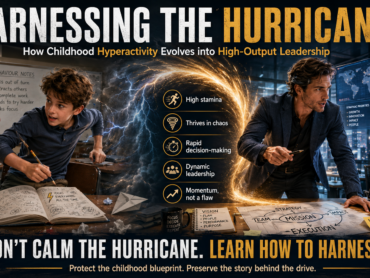
Despite the systemic drop-offs, that raw childhood energy doesn’t disappear. In the real world, constant movement and high sensory input aren’t design flaws – they are elite performance features. When a highly energetic child grows up and learns how to channel that internal motor, they become high-output, high-stamina leaders who pull entire teams into their orbit.
What a specialized primary department once helped a child manage scales into powerful adult professional advantages:
-
Unrivaled Stamina and Output Baseline: While an average workload can drain a standard professional, an adult with a channeled energetic baseline can effortlessly manage a dozen moving parts at once. They possess a high-capacity internal motor that allows them to outpace and out-produce the competition without hitting an immediate wall.
-
Thriving in Chaos (The Crisis Advantage): Standardized environments demand linear logic, but crises are loud, messy, and unpredictable. A brain wired for high stimulation doesn’t panic in a fast-breaking corporate crisis; it actually stabilizes. They can process multiple incoming data streams rapidly, making high-stakes decisions under intense pressure while others are still processing the shock.
-
Infectious, Dynamic Leadership: Kinetic leaders don’t manage from a spreadsheet; they lead with a visceral, magnetic energy. Their natural momentum is highly contagious, making them phenomenal at rallying teams, pitching vision to investors, and disrupting stagnant markets.
Why EdiWay is the Portable Passport for Your Mind
When a primary school took the time to recognise your needs, it generated a wealth of invaluable, highly specific data. These weren’t just standard grades; they were detailed clinical notes, speech therapy milestones, and deeply personalized behavioral blueprints mapping exactly how your brain interacted with the world. Losing that paper trail at secondary school is a tragedy; having it completely shredded by the local authority at age 25 is an injustice.
This is exactly why we built EdiWay.
EdiWay acts as an unbroken, portable educational passport owned by the family, not the state. It solves the transition crisis by ensuring parents can hand secondary schools the unarguable, complete digital archive of what worked in primary school on day one.
More importantly, it solves the adulthood crisis. By giving users the ability to notify and transition their data into verified adult accounts before the age-25 purge, EdiWay ensures that when you are nearly 40, you aren’t left guessing at your own factory settings. We don’t want to calm the hurricane, and we don’t want the system to erase it. We want to give you the lifelong data to harness it.